
See the Real Earnings Behind the Numbers.
Quality of Earnings Reports for Business Acquisitions
Validate reported earnings, uncover questionable add-backs, and understand the true, sustainable financial performance of the business before you commit.
Quality of Earnings and Financial Due Diligence Projects
$1M-$15M
Typical Acquisition Size
More Affordable Than Large Regional CPA Firms
Real Acquisition Experience
Our Team of CPAs Have Personally Acquired Businesses
Education
What Is a Quality of Earnings Report?
A Quality of Earnings Report, also called a QOE Report or Financial Due Diligence Analysis, helps buyers understand whether a company's reported earnings reflect its true operating performance before completing an acquisition.
Ultimately, it answers one simple question: are the numbers real, and are they sustainable?
A thorough Quality of Earnings Analysis gives buyers, lenders, and investors the clarity to close with confidence, or walk away before a costly mistake.
Revenue Quality
Is revenue recurring, reliable, and accurately reported?
EBITDA Adjustments
Which add-backs and normalizations are legitimate?
Working Capital
What capital is actually needed to run the business?
Cash Flow
Is the business generating real, consistent free cash flow?
Customer and Vendor Risk
Concentration risk and single-customer dependency.
Financial Trends
Is the business growing, stable, or declining, and why?
Debt and Hidden Liabilities
Liabilities or obligations that should reduce the purchase price.
Why Quality of Earnings Reviews Matter
A company is worth what it can keep earning, so the useful question about historical results is which parts of them will continue. Appletree reviews reported earnings against what the business actually sustains, and reports the difference.
Avoid Financial Surprises
A single customer can account for most of recent revenue. A one-time expense can turn out to recur every year. We surface those before they surface in negotiation, when they cost far more to absorb.
Identify Risks and Opportunities
The same review that flags concentration risk and unsupported add-backs also finds margin the seller never highlighted. Buyers use both: one to reprice the deal, the other to plan the first year of ownership.
Gain Confidence in Financial Decisions
Lenders and investment committees want the earnings figure defended, not asserted. We give you an adjusted number with the reasoning attached, so the people funding the deal can follow how it was reached.

When Your Business Needs a Quality of Earnings Review
Quality of earnings reviews are most commonly associated with mergers and acquisitions, although they can be valuable in several situations.
A business owner preparing to sell a company may obtain a sell-side quality of earnings review before entering the later stages of a transaction. Reviewing the financials in advance can identify issues that a prospective buyer is likely to question and give the seller an opportunity to organize supporting information.
A buyer may use a buy-side QoE review during financial due diligence to determine whether the earnings presented by the seller are supported by the underlying records. Investors and lenders may also want greater visibility into financial performance before committing capital.
Who We Help
Is This Right for Your Acquisition?
Appletree's Quality of Earnings and Financial Due Diligence work is built for buyers across the lower middle market.
Search Funds
SBA Buyers
Acquisition Entrepreneurs
Private Equity
Independent Sponsors
Strategic Buyers
Business Buyers
Lenders and Investors
Appletree specializes in business acquisitions with purchase prices typically between $1M and $15M, the sweet spot for Search Funds, SBA Buyers, Acquisition Entrepreneurs, and Lower Middle Market Private Equity firms.
Our Process
Our Quality of Earnings Review Process
A clear, defined process from first call to final report, you'll always know exactly where things stand.
Initial Consultation
We learn about your acquisition, deal timeline, and what you need from the engagement.
Document Request
We send a structured request list to gather the seller's financial records.
QOE Analysis
Our CPAs dig into revenue, EBITDA, working capital, cash flow, and risk factors.
Report & Scorecard
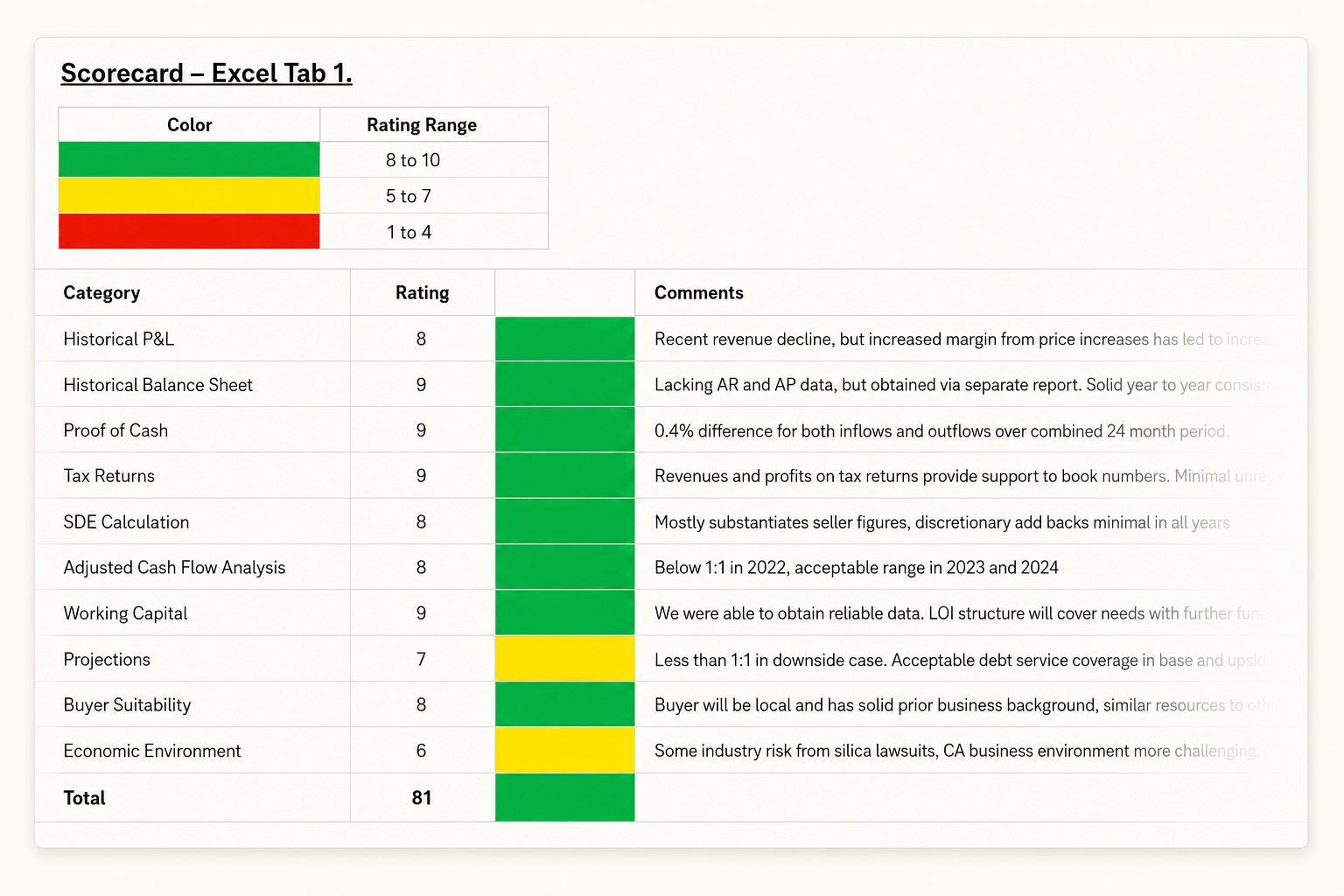
We deliver your QOE Report and the Appletree Acquisition Scorecard with clear findings.
Findings Review
We walk through the report, answer questions, and give practical recommendations.
Sample Report
See Exactly What You'll Receive
Our Quality of Earnings Reports are built to be clear, actionable, and buyer-ready, not dense with accounting jargon. Every Quality of Earnings Report includes our proprietary Acquisition Scorecard: a plain-English summary of exactly what we found and what it means for your decision.
- Easy-to-read executive summary
- EBITDA bridge and adjustments
- Revenue and cash flow quality assessment
- Working capital and hidden liability analysis
- Proprietary Appletree Acquisition Scorecard

Understanding Normalized Earnings and EBITDA
One of the most important concepts in many quality of earnings engagements is normalized earnings. A company's reported results reflect what actually occurred during a particular period. Normalized results attempt to show what earnings might have looked like without unusual, nonrecurring, or owner-specific items that are not considered part of ordinary continuing operations.
EBITDA, which refers to earnings before interest, taxes, depreciation, and amortization, is commonly used in business transactions as one measure of operating performance. Transaction discussions may also involve adjusted EBITDA, which makes additional adjustments to reported results.
QUALITY OF EARNINGS
Quality of Earnings for Both Sides of the Deal
Whether you're evaluating an acquisition or preparing your company for sale, a Quality of Earnings review gives you greater clarity before negotiations and due diligence begin.

BUY SIDE
Know What You're Really Buying.
A Buy-Side Quality of Earnings review goes beyond the seller's reported numbers to help you understand the true financial performance of the business before you close.
-
Validate reported earnings and EBITDA adjustments
-
Identify revenue, margin, and customer concentration risks
-
Uncover financial issues that could impact deal value
-
Understand where additional due diligence may be needed

SELL SIDE
Prepare Before the Buyer Starts Asking Questions.
A Sell-Side Quality of Earnings review helps you see your financials through a buyer's eyes—giving you time to address issues and support your numbers before due diligence begins.
-
Identify questions buyers are likely to raise
-
Support legitimate EBITDA adjustments and add-backs
-
Organize financial documentation before due diligence
-
Present a more defensible picture of normalized earnings
Not Sure Which Type of Review You Need?
Our team can help you determine the right approach based on your goals.
A Quality of Earnings Review Is Not an Audit
A quality of earnings review and a financial statement audit are different services with different objectives.
An audit is performed under specific professional standards and is designed to provide an opinion regarding whether financial statements are presented fairly, in all material respects, according to the applicable financial reporting framework.
A quality of earnings review is typically a transaction-focused financial analysis. Rather than issuing an audit opinion, the QoE process focuses on understanding the composition and sustainability of earnings, evaluating financial trends, and identifying issues that may be relevant to a buyer, seller, lender, or investor. A company can therefore have accurate financial statements and still benefit substantially from a quality of earnings review before a transaction.
Why Appletree
Why Business Buyers Choose Appletree
100+ Quality of Earnings and Financial Due Diligence engagements - purpose-built for the lower middle market, not corporate M&A.
100+ QOE and Due Diligence Projects
Real pattern recognition built across more than 100 Quality of Earnings and Financial Due Diligence engagements.
$1M–$15M Acquisition Specialists
Focused on the lower middle market, SBA deals, search funds, and acquisition entrepreneurs at the size that matters to you.
Search Funds, SBA Buyers and Entrepreneurs
Acquisition buyers across the country rely on Appletree for independent Buy-Side Due Diligence.
Real Acquisition Experience
Our CPAs have personally bought businesses, so we know what buyers actually need, not just what looks good on paper.
Thorough, Diligent and Pragmatic
Practical, buyer-focused findings, not dense technical reports that need a second interpreter.
20–50% More Affordable
QOE Analysis at a fee that fits real acquisition budgets, typically well below large regional CPA firms.
Traditional CPA Firms
Generic, templated reports
Built for large corporate transactions
Higher fees, less accessible
Limited real acquisition experience
Technical reports that are hard to interpret
The Appletree Difference
- 100+ Quality of Earnings and Financial Due Diligence engagements
- Designed for $1M–$15M business acquisitions
- CPAs who have personally acquired businesses
- Clear, actionable reports you can actually use
- Typically 20–50% more affordable than large regional firms
Community Partners
Trusted by Business Buyers From
Many of our Quality of Earnings clients come from some of the most respected communities in small business M&A.




Industry Recognition
Featured On Leading M&A Podcasts
Our team has also been featured on respected podcasts focused on business acquisitions, search funds, and the lower middle market.



Related Services
Bookkeeping Services: Maintain organized, timely financial records that provide a clearer picture of business performance.

Mergers and Acquisitions

Financial Due Diligence

Bookkeeping Services

Outsourced CFO Services

Business Consulting

Tax Services
Areas Served
Where We Work
Appletree runs quality of earnings reviews remotely for acquisitions across the country, working from accounting files, bank records, and management interviews. The analysis does not change with distance, though industry and deal structure both change it considerably.
The firm works from offices in Londonderry and Portsmouth, New Hampshire, and takes on transactions wherever the buyer and the target happen to be.

FAQs About Quality of Earnings Review Services
The scope depends on the company and transaction, but a quality of earnings review commonly analyzes historical revenue, operating expenses, profitability, EBITDA adjustments, nonrecurring items, owner-related expenses, customer concentration, margins, working capital trends, and other factors that may affect sustainable earnings.
The review may also evaluate supporting documentation for significant adjustments and identify financial trends or inconsistencies that deserve additional investigation.
A financial statement audit and a quality of earnings review serve different purposes.
An audit is performed according to established professional standards and provides an opinion regarding financial statements. A QoE review is generally performed as part of transaction-related financial due diligence and focuses on understanding the composition, consistency, and sustainability of earnings.
A quality of earnings review does not replace an audit, nor does an audit necessarily provide the transaction-specific analysis available through a QoE engagement.
The timeline varies depending on the size and complexity of the company, the scope of the engagement, the quality of existing financial records, and how quickly requested information can be provided.
Businesses with organized accounting records and accessible supporting documentation generally make the review process more efficient. Companies preparing for a future sale can benefit from addressing bookkeeping and reporting issues before transaction due diligence begins.
Adjusted EBITDA begins with EBITDA and makes additional adjustments intended to account for certain unusual, nonrecurring, discretionary, or transaction-specific items.
Common proposed adjustments may include one-time professional fees, unusual repairs, certain owner-specific expenses, or other costs that are not expected to continue under new ownership.
Every adjustment should be evaluated individually. Simply labeling an expense an "add-back" does not necessarily mean it represents a valid adjustment to sustainable earnings.
For some businesses, completing a sell-side QoE review before intensive buyer due diligence can be valuable.
The process can identify financial issues, help support legitimate adjustments, improve the organization of financial information, and reveal questions a prospective buyer may raise. Addressing those matters earlier can help the seller enter due diligence better prepared.
A buyer may benefit from a QoE review when the target company's historical earnings are an important factor in determining value or negotiating transaction terms.
The analysis can help the buyer understand what produced reported profits, whether proposed adjustments are supportable, and which financial trends deserve additional consideration before completing the acquisition.

Ready to Get Started?
Major business transactions require more than a quick review of an income statement. Understanding where earnings come from, what has influenced historical performance, and which results may be sustainable can provide valuable context before you commit to a sale, acquisition, or investment.
Whether you are preparing your company for a sale, evaluating an acquisition, or seeking greater confidence in the financial information behind a transaction, our team can help you understand the numbers before important decisions are made. Schedule your free consultation with Appletree Business Services today to discuss your quality of earnings review and the next steps for your transaction.
Testimonials
Here’s What Our Clients Have to Say
"They are incredibly on top of things and always available for anything and everything! Appletree Business Services has simplified the client's tax processes, meeting expectations. The team delivers on time and is always available for any concerns. Communication is efficient via virtual meetings and email. They have a personal touch that helps with all accounting needs.”
 Jason Pak VP, Achieve Fitness Center, Inc.
"I loved that they have been through the business-buying process and trusted their experience in that realm. Thanks to Appletree Business Services' work, the client found information regarding the potential financial risk of buying the business and ultimately decided not to acquire it. The team was responsive and delivered on time. Their experience in the business-buying process was impressive.”
 Bryan Tibbitts Searcher, TibbCo Ventures LLC
"If you're looking for a reliable and professional accounting firm, we highly recommend Appletree Business Services. Appletree Business Services has provided the client with financial clarity, improved efficiencies, and accurate payroll. The team is responsive, knowledgeable, and understanding of the industry. The client has been impressed with the team's responsiveness and expertise throughout the engagement.”
 Maribel Olvera Owner, Boston Budget Plumbing. Heating and Cooling
"They deliver on time. Appletree Business Services has successfully cleaned the client's books according to their requirements. So far, the team has delivered on time, communicated through virtual meetings, and shown an alignment of values with the client. Overall, it has been a satisfying partnership.”
 Gabriel Gorelik COO, United settlement
"They were very responsive during the transition and beyond and made me feel very comfortable. Appletree Business Services has successfully transitioned the client's internal financial processes to their system on time. The team has been highly responsive and competent throughout the workflow, easing the transition. They deeply understand the client's needs to keep their business running.”
 Ian McKenna Owner, InTech Scientific
"The team has been very helpful. Appletree Business Services' work has helped the client update and upgrade their Quickbooks platform and optimize their processes. Appletree Business Services' team is responsive, punctual, and committed to the project's success. The client also praised the team's ability to fully explain every step of the process.”
 McKenzie Reed President, CLN of South Florida, Inc.
"I'm impressed with their ability to understand and organize books while doing everything remotely. So far, the client has been doing a great job of meeting the client's needs. Appletree Business Services works in an organized manner, enabling them to complete tasks on time and with accuracy. Moreover, the team has impressed the client with their communication skills.”
 Rob DeVerna Executive Director, Rye Venue Management
"They are impeccably reliable and always reply to requests or questions quickly. The client is delighted with Appletree Business Services' work. The team constantly looks for new ways to help with financial aspects and offers insights for better decision-making. They are reliable, responsive, and endlessly helpful. Their genuine care for the company is impressive.”
 Nicki Krawczyk President, Nicki K Media, Inc
"Marlo at Appletree is great to work with. Quick work with confirmations!”
 Henry Gaumont Henry Gaumont
"I've been working with Appletree Business Services for almost a year now, and I couldn't be happier with the service. Nehemiah Barr, our accountant, is exceptional. He's not only knowledgeable and detail-oriented, but he also takes the time to explain complex financial matters in a way that's easy to understand. I highly recommend them to any business looking for reliable and expert accounting support.”
Arturo Ramírez Arturo Ramírez"Working with Appletree Account has been a great experience. Nehemiah has been diligent and exudes professionalism. As a small business owner it has been a game changer and has freed up time to focus on my business. 100% Recommend.”
Eamon Sullivan Eamon Sullivan"Absolutely amazing experience with Appletree Business Services! As the owner of 817 Coffee, a small coffee roastery, I can confidently say that Appletree has been a game-changer for us. Nehemiah, our Accounting and Tax Manager, has been incredibly responsive and supportive, making the financial side of our business stress-free. His expertise and guidance have allowed us to focus on our passion - roasting the best coffee in the world. We are so grateful for Nehemiah and the entire team at Appletree for their dedication to making our lives easier. Highly recommend their services to any small business owner!”
 Johann Joseph 817 Coffee
"I've been working with Nehemiah Barr and his team at Appletree for the better part of a year. They handle 2 different businesses of mine and have been a tremendous help. From cleaning up the books and flushing out mistakes from previous accountants to implementing new processes for the future he has been an invaluable asset. I would highly recommend him to others!”
 Christopher Janeway Christopher Janeway
"We highly recommend Appletree. They allow us to do what we do best in our business. They are extremely responsive, helpful and respectful!We are happy to continue our services with them that includes book keeping, payroll, and tax prep throughout the year. All bundled into a simple monthly payment. Thank you appletree for all of your hardwork!”
 Grateful Electric LLC Grateful Electric LLC
"Appletree is not your standard accounting firm. They provide me with insights into my business numbers, and empower me with financial knowledge, fueling the sustained growth of my business. Having someone to advise us has been invaluable.”
 Casey Cheshire Cheshire Impact LLC
“We had no idea about all the problems we had until Appletree applied the Business Financial Confidence Map to our practice, guiding us through many compliance issues, and giving us peace of mind.”
 Dr. John Kosinski East Coast Chiropractic LLC
“For over 15 years, Appletree has provided exceptional accounting services and business advice. Knowing that I don’t have to think about taxes and compliance allows me to concentrate on running the business. It’s a huge relief never having to worry.”
 Karen Ferrandino Freedom Dental Arts LLC
I look at my books and all my accounts are organized. I love having it all in one spot. You guys help me sleep.
 Michael D Smith The Weatherize Guyz, LLC, Derry, NH
We made so many changes for the positive since we hired Appletree. I feel like we finally have somebody on our side, a whole team behind us.
 Karen Fenderson Creative Little Angels, Londonderry, NH
It’s comforting to know we have someone outside of our office scrutinizing our trends and bringing them to our attention. It’s easy to get caught up in the day to day letting the global issues slip by.
 Christian Larocca Progressive Electrical Services, Lee, NH
Appletree spent a lot of time learning how we work. They really understand us, and we found they are very easy to work with. I love how they put it all together as one package.
 Michael Rioux Grass Gobblers Lawn Care & Landscaping, Londonderry, NH
Appletree has helped me navigate and resolve multiple tax-related issues for my small business. Without them, I’d still be going blind on paperwork and research, and my issues would not yet be resolved.
 Todd Campbell E. B. Capital Markets LLC, Durham, NH
With accurate, easy to understand monthly reports that give us accountability & a reminder to “check the oil” in our fiscal machine, Appletree has proven to be one of the best financial decisions made in twelve years of business!
Christian Larocca Progressive Electrical Services, Lee, NHAppletree helped with the purchase of our practice, making sure we had no disruption to our patients or insurance providers’. Their business financial confidence map helped us pay the minimum in taxes and their payroll allows us to focus on billing.
 Joshua Dion Integrated Pain Care LLC, Bedford, NH
We had no idea about all the problems we had until Appletree applied the Business Financial Confidence Map to our practice, guiding us through many compliance issues, and giving us peace of mind.
 Casey Cheshire East Coast Chiropractic LLC, Manchester NH
We’ve used Appletree for the past decade and have seen our sales increase 100% over that time. Their experience & knowledge has also saved us thousands of dollars in tax credits.
 Dana Robinson Robinson Precision Tool Corporation, Hudson, NH
Steve has done all of my accounting work since 1995. I’ve benefited from his help and guidance through the years in virtually every major financial decision that I’ve made. His wisdom and experience is invaluable.
 Kevin Hallenbeck Sandler Sales Training, Bedford, NH
It has gone extremely well and I continue to use their services on an ongoing basis as an integral part of my business. I get more than my money’s worth.
 Craig Bailey Customer Centricity, Inc, Hudson, NH
Over the past 20 years, They find the right questions to ask that help lead us to make the right choices…. Their system has made it easy for my husband and myself to continue doing what we like to do best—our work.
 Jeanne Hall, NHLMT, NCMMT Jeanne Hall Therapy, Derry, NH


Schedule Your Free Consultation Today
Get bookkeeping, payroll, tax, and advisory support from a proactive team that understands electrical contracting and the unique financial challenges your business faces.
What Is a Quality of Earnings Review?
A quality of earnings review, often referred to as a QoE review, is a detailed financial analysis used to determine how closely a company's reported earnings reflect its normal, sustainable operating performance.
Financial statements may be accurate while still including items that make current profitability different from what a new owner or investor could reasonably expect going forward. A business might have experienced an unusual one-time expense, received nonrecurring income, paid discretionary expenses for an owner, changed accounting practices, or benefited from circumstances that are unlikely to continue. A quality of earnings review helps put those items into context.

Our Quality of Earnings Review Process
Every company is different, which means a quality of earnings engagement should reflect the size, complexity, transaction, and available records of the business being reviewed.
Appletree approaches the process with a focus on clear financial analysis, practical communication, and information that business owners and transaction participants can use.

1
Initial Consultation and Information Review
The process begins with understanding the company and the reason for the review. We discuss the business model, transaction context, reporting structure, available accounting records, and areas requiring particular attention. This initial stage also helps establish the appropriate scope of the quality of earnings review.
Financial information may include income statements, balance sheets, general ledger data, tax information, payroll records, revenue reports, bank information, and supporting documentation relevant to significant adjustments. The objective is to establish a reliable foundation for the analysis before drawing conclusions from the numbers.
2
Comprehensive Reporting and Recommendations
The next stage focuses on examining historical financial performance and understanding the factors behind reported earnings. We look for trends, inconsistencies, unusual transactions, and items that may require additional explanation. Depending on the scope of the engagement, this can include evaluating proposed adjustments to reported EBITDA and determining whether those adjustments reflect expenses or income that are genuinely nonrecurring.
3
Comprehensive Reporting and Recommendations
Once the analysis is complete, the findings are organized into a clear report that explains the important financial observations uncovered during the review.
Rather than presenting unexplained numbers, an effective quality of earnings report should help users understand what those numbers mean and why particular adjustments or trends matter. Our team can also help business owners understand the findings and determine what additional financial preparation may be appropriate as a transaction progresses.